







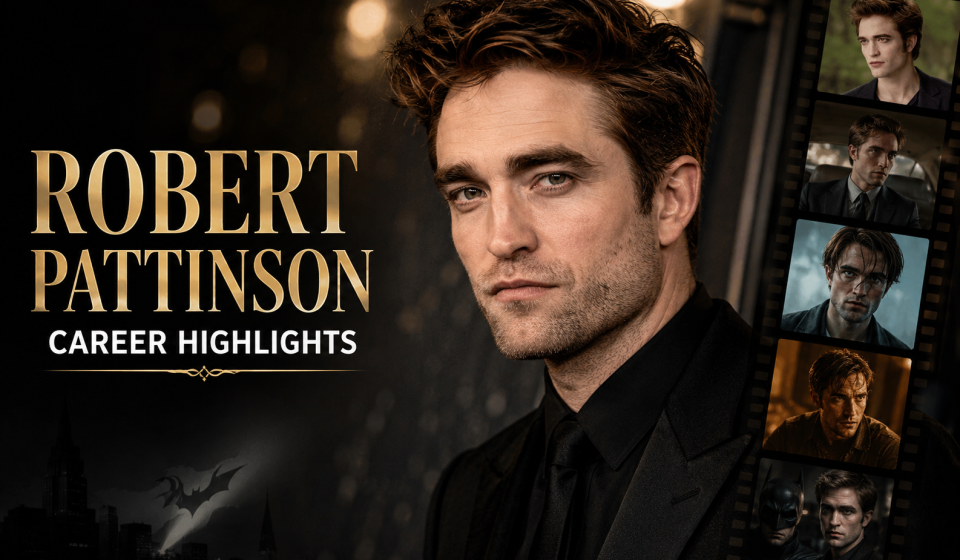
Robert Pattinson Career Highlights: From Twilight’s Reluctant Vampire to Hollywood’s Busiest Auteur Favorite

Few actors have engineered a more deliberate escape from typecasting than Robert Pattinson. After becoming a global phenomenon playing a brooding vampire in a teen franchise he was, by his own admission, never particularly fond of, he spent the following decade quietly rebuilding his reputation from the ground up — through some of the strangest, riskiest independent films he could find. Now, at 40, he’s not just recovered from the Twilight association; he’s become one of the most in-demand actors working with the industry’s most respected directors, all while starring in five different films in a single year, an output that would be remarkable for an actor at any career stage.
Here’s how that transformation actually happened.
Early Life and an Unplanned Path Into Acting
Robert Pattinson was born on May 13, 1986, in London, England, and grew up in Barnes, a well-off district in the southwest of the city. His entry into acting wasn’t part of a lifelong plan — he started out in amateur theatre productions, the kind of low-stakes, local performing that rarely leads anywhere in particular for most who try it. His actual breakthrough came almost by accident, landing the role of Cedric Diggory in Harry Potter and the Goblet of Fire in 2005, a supporting part in one of the biggest franchises in the world at the time, and his first real exposure to large-scale filmmaking.
Twilight: Fame He Didn’t Fully Want
Three years later, Pattinson was cast as Edward Cullen in Twilight (2008), a role that would define — and for a long time, limit — how the public saw him for years afterward. The franchise went on to gross over $3.3 billion worldwide across five films, making him one of the most recognizable young actors on the planet almost overnight.
What’s notable, in hindsight, is how openly uncomfortable Pattinson was with the character and the franchise’s reception. In a 2008 interview with Empire, he described Edward in strikingly unflattering terms — a manic-depressive, self-hating figure who happened to also be, in his own phrasing, a 108-year-old virgin with some obvious issues. That kind of candor about a role that made him famous is unusual, and it set the tone for how deliberately he’d try to separate himself from the character once the franchise ended.
The Deliberate Pivot: Independent Film as Reputation Repair
After Twilight concluded with Breaking Dawn – Part 2 in 2012, Pattinson made a conscious, sustained effort to rebuild his career around serious, director-driven independent cinema rather than chasing another franchise or blockbuster. He worked with Guy Pearce on The Rover, appeared alongside Nicole Kidman and James Franco in Queen of the Desert, and took on Cosmopolis (2012) under David Cronenberg — an unconventional, dialogue-heavy film that was about as far from Twilight’s tone as an actor could reasonably get.
That pattern continued and intensified with Good Time (2017), a gritty crime thriller from the Safdie brothers that earned him some of the strongest reviews of his career, and The Lighthouse (2019), a stark, black-and-white psychological drama opposite Willem Dafoe. Together, these roles did exactly what Pattinson seemed to be aiming for: they replaced “the guy from Twilight” with “a serious actor who takes real risks,” a reputation shift that took years of consistently strange, uncommercial choices to actually earn.
Christopher Nolan and the Return to Mainstream Cinema
Pattinson’s re-entry into major studio filmmaking came through Christopher Nolan‘s Tenet (2020), a big-budget, high-concept action thriller that put him back in front of mainstream audiences without undoing the independent-film credibility he’d spent nearly a decade building. It’s a fairly rare needle to thread — returning to blockbuster visibility while keeping the respect earned through smaller, riskier work — but the choice of Nolan specifically, a director known for prestige as much as scale, made the transition feel consistent with everything he’d done since Twilight rather than a step backward.
Becoming Batman
In 2022, Pattinson took on one of the most scrutinized roles in modern film: Bruce Wayne in Matt Reeves’ The Batman. The film leaned into a darker, more grounded, detective-driven take on the character, distancing itself from previous cinematic versions, and Pattinson’s performance was widely well-received — a genuine validation of the years spent building dramatic credibility, now applied to one of the most recognizable characters in pop culture history. A sequel, The Batman: Part II, is set for release in 2027, extending his run with the character into its second decade of association, following in the footsteps of previous Batman actors including Adam West, Michael Keaton, Christian Bale, and Ben Affleck.
2025: A Genuinely Packed Year
Pattinson’s workload picked up significantly heading into 2025 and 2026. That year alone included Mickey 17, a science-fiction satire that crossed a notable global box office milestone despite a slow initial start, and Die My Love, a horror-tinged drama opposite Jennifer Lawrence in which the two play a married couple navigating serious psychological strain. That range — satire, horror-drama, and everything in between — reflected the same restless unwillingness to repeat himself that’s defined his post-Twilight choices for over a decade.
2026: A Record-Setting Five Films
By 2026, Pattinson’s pace reached a genuinely unusual level even by his own standards: five different films featuring him were scheduled for release within the same year, setting a new personal record for the actor and placing him among the busiest leading men in the industry that year. That slate included The Drama, an A24 dark romantic comedy opposite Zendaya about an engaged couple confronting unexpected revelations on the eve of their wedding — a film that grossed $123 million worldwide on a modest $28 million budget and earned strong reviews from critics. It also included his reunion with Christopher Nolan on The Odyssey, playing Antinous, the most prominent of Penelope’s suitors in Homer’s original story and the first to be killed by Odysseus upon his return — a morally complicated, ultimately doomed character within an enormous ensemble cast that includes Matt Damon, Tom Holland, Zendaya, Anne Hathaway, and Charlize Theron.
Rounding out the year, Pattinson also appears in Dune: Part Three alongside Timothée Chalamet, adding yet another major franchise to an already stacked slate, alongside additional smaller projects that continued his pattern of mixing scale with genuinely idiosyncratic choices.
Turning 40 With No Signs of Slowing Down
Pattinson celebrated his 40th birthday on May 13, 2026, a milestone that arrived in the middle of what’s arguably the busiest, most visible stretch of his entire career. Rather than the kind of gradual mid-career plateau that affects many actors around this age, his 2026 output — five films spanning romantic comedy, epic ensemble drama, and continued franchise commitments — suggests a career that’s still actively accelerating two decades after Harry Potter first put him on screen.
Personal Life: Fatherhood and a More Guarded Public Presence
Pattinson has been in a relationship with model and musician Suki Waterhouse since 2018, with the couple becoming engaged in December 2023 and welcoming a daughter together in 2024. Speaking to GQ in January 2026 about fatherhood, he described his own shift in perspective candidly, admitting he wasn’t previously someone especially drawn to children but has found the experience of raising his own daughter to be, in his words, absolutely wonderful.
That openness about fatherhood stands in contrast to how tightly he’s generally guarded the rest of his personal life. Following intense tabloid coverage of his earlier, high-profile relationships with Kristen Stewart and later FKA Twigs during and after the Twilight years, Pattinson has become known for keeping his private life deliberately private, even admitting in interviews to occasionally giving deliberately misleading answers to journalists rather than engaging with invasive questions directly — an unusual but fairly understandable response to years of intense media scrutiny during his most famous period.
Why His Career Arc Stands Out
Looking at the full picture, what makes Pattinson’s trajectory genuinely distinctive is the sheer deliberateness of it. Plenty of actors who achieve franchise-level fame young end up either leaning permanently into that identity or spending years unsuccessfully trying to shed it. Pattinson did neither — he used the platform Twilight gave him to fund and access a string of genuinely uncommercial, director-driven projects, patiently rebuilt his critical reputation almost from scratch, and only returned to blockbuster-scale work once that reputation was secure enough to survive the transition.
The result is a career that now spans teen vampire romance, Cronenberg-directed experimental cinema, Safdie brothers crime thrillers, Christopher Nolan epics, and a definitive modern take on Batman — a genuinely unusual range for any single actor to have moved through convincingly, let alone one who started as the face of a franchise built almost entirely on a single romantic archetype.
Comparing His Reinvention to Other Franchise Stars
Pattinson’s post-Twilight trajectory is frequently cited alongside a small handful of other actors who successfully escaped a defining teen-franchise role without spending the rest of their careers trying to outrun it. What sets his path apart is the sheer commitment to discomfort during the rebuilding years — rather than easing into slightly more mature mainstream roles, he went almost immediately toward the most challenging, least commercially safe work available, with directors like Cronenberg and the Safdie brothers who had no particular incentive to soften his image for a broader audience.
That willingness to be genuinely uncomfortable on screen, rather than simply “serious” in a marketable, easily digestible way, is a large part of why critics and industry insiders came to view his post-Twilight work as authentic reinvention rather than a calculated image rehabilitation campaign. The distinction matters — audiences and critics alike tend to be able to tell the difference between an actor genuinely chasing difficult material and one performing seriousness for optics, and Pattinson’s choices consistently read as the former.
The Role of Directors in Shaping His Career
A recurring pattern across Pattinson’s post-Twilight filmography is his attraction to directors with strong, singular creative visions rather than simply chasing the biggest available roles. David Cronenberg, the Safdie brothers, Robert Eggers on The Lighthouse, and eventually Christopher Nolan on both Tenet and The Odyssey — each represents a filmmaker known for a highly specific, uncompromising creative voice rather than conventional studio filmmaking.
That consistent gravitation toward auteur-driven projects has become something of a signature in how his career gets discussed within the industry, distinguishing him from actors who simply alternate between big paydays and prestige projects without a clear creative throughline connecting their choices. For Pattinson, the throughline appears to be a genuine interest in working with directors who have something specific and uncompromising to say, regardless of whether the resulting film is a modest arthouse release or a massive studio epic.
Managing Fame on His Own Terms
Beyond the roles themselves, Pattinson’s approach to fame has evolved into something distinctly his own. Rather than either fully embracing tabloid visibility or disappearing from public life entirely, he’s settled into a middle path — engaging with press tours and promotional obligations while remaining deliberately guarded about anything personal, sometimes to a degree that borders on playful misdirection in interviews. That approach, born partly out of the intense scrutiny of his Twilight-era relationships, has allowed him to maintain a substantial public career without the kind of constant personal exposure that defined his twenties.
The Contrast Between His Early and Current Public Image
It’s worth pausing on just how different Pattinson’s current public perception is from where it stood immediately after Twilight ended. In the early 2010s, he was primarily known as a heartthrob tied to a franchise many critics dismissed outright, with tabloid coverage of his personal life often overshadowing serious discussion of his acting choices. By 2026, the conversation around him centers almost entirely on his range as a performer and his collaborations with some of the most respected directors working today — a genuinely rare shift in how an actor gets discussed within the industry and by critics.
That transformation didn’t happen through a single interview, a rebrand campaign, or a carefully staged image overhaul. It happened through roughly fifteen years of consistent, deliberate choices, each one reinforcing the same underlying message: that the actor beneath the Twilight fame was always more interested in difficult, director-driven work than in simply maintaining the kind of visibility the franchise handed him.
Conclusion
Robert Pattinson’s career highlights tell a story of deliberate reinvention rather than simple, steady rise. From an accidental start in amateur theatre through unexpected global fame in Twilight, a role he was famously ambivalent about, to a decade spent rebuilding genuine critical respect through independent film, and finally back to major studio filmmaking as Batman and a Christopher Nolan regular, his path reflects a level of career-shaping intentionality that’s rare even among actors with comparable longevity and comparable early franchise fame.
At 40, with a record five films in a single year, a sequel to The Batman on the way, and continued collaborations with some of the industry’s most respected directors, Pattinson’s career looks less like a comeback story and more like the payoff of a decade-long, patiently executed plan to control exactly how his own reputation would be rebuilt.
The Financial Logic Behind Balancing Franchise and Independent Work
There’s a practical dimension to Pattinson’s career strategy worth acknowledging alongside the creative one. Major franchise commitments like Batman and Dune provide the kind of financial security that makes riskier, lower-budget independent projects genuinely feasible without jeopardizing an actor’s livelihood. That arrangement — using blockbuster paydays to fund creative freedom on smaller films — has become an increasingly common model among actors trying to sustain both commercial relevance and artistic credibility simultaneously, and Pattinson’s career offers one of the clearer examples of it working as intended over an extended period.
Without the financial cushion Twilight initially provided, and later Batman and other franchise work reinforced, it’s less certain he could have afforded to take on as many uncommercial, director-driven passion projects throughout his thirties. That interplay between blockbuster income and independent ambition is easy to overlook when focusing purely on the artistic side of his choices, but it’s arguably just as important to understanding how the strategy has been sustainable for well over a decade.
What Comes Next
With The Batman: Part II confirmed for 2027 and a 2026 slate that’s already set a personal record for output, Pattinson heads into the coming years with a rare combination of franchise stability and continued access to prestige, director-driven projects. Given the pattern established over more than a decade, it’s a reasonable bet that whatever follows will continue mixing large-scale studio commitments with the kind of genuinely strange, uncommercial choices that first rebuilt his reputation after Twilight — rather than settling comfortably into either category exclusively, or trading the range that’s defined his entire post-Twilight identity for the safety of predictable, repeatable success.
Frequently Asked Questions
What was Robert Pattinson’s first major role? He first gained attention playing Cedric Diggory in Harry Potter and the Goblet of Fire (2005), though his breakout to global fame came three years later with Twilight (2008), a role that would define the first phase of his career.
How much did the Twilight franchise gross overall? The five-film Twilight Saga grossed over $3.3 billion worldwide, making Pattinson one of the most recognizable young actors globally following its release and setting the stage for the deliberate reinvention that followed once the franchise concluded.
What role does Robert Pattinson play in The Odyssey? He plays Antinous, the most prominent of Penelope’s suitors in Homer’s original story, in Christopher Nolan’s 2026 adaptation, appearing alongside Matt Damon, Tom Holland, Zendaya, Anne Hathaway, and Charlize Theron in one of the year’s most anticipated ensemble films.
Is Robert Pattinson still playing Batman? Yes, he is set to reprise the role in The Batman: Part II, expected for release in 2027, following his acclaimed performance in The Batman (2022), which brought a darker, more detective-driven take on the character to the screen.
How many films does Robert Pattinson have releasing in 2026? Five films featuring Pattinson were scheduled for release in 2026, setting a new personal record for the actor, including The Drama, The Odyssey, and Dune: Part Three, spanning romantic comedy, mythological epic, and science-fiction franchise filmmaking within a single calendar year.
Is Robert Pattinson married? He is engaged to model and musician Suki Waterhouse, with the couple together since 2018, engaged since December 2023, and parents to a daughter born in 2024, though they have chosen not to publicly share their daughter’s name.
What independent films helped rebuild Robert Pattinson’s career after Twilight? Key films included Cosmopolis (2012) with David Cronenberg, Good Time (2017) from the Safdie brothers, and The Lighthouse (2019) opposite Willem Dafoe, all of which earned significant critical acclaim.
Did Robert Pattinson always want to distance himself from Twilight? Yes, he was notably candid in interviews about his ambivalence toward the Edward Cullen character even during the franchise’s run, and consistently pursued smaller, more challenging independent films once it concluded rather than similar mainstream roles, a pattern that held for the better part of a decade.
What is Robert Pattinson’s connection to Timothée Chalamet? The two co-star together in Dune: Part Three, part of Pattinson’s record five-film slate in 2026, joining an ensemble that includes several of the era’s most prominent young leading actors working across major franchise filmmaking today.
How does Robert Pattinson choose which projects to take on? His career shows a consistent pattern of gravitating toward directors known for strong, singular creative visions, including David Cronenberg, the Safdie brothers, Robert Eggers, and Christopher Nolan, rather than simply pursuing the highest-profile available roles, a pattern that’s held remarkably steady for well over a decade.
